
blog
This Month in HeatSync May 2026
A monthly roundup of what got built, broken, organized, donated, hacked, and shipped at HeatSync Labs in Mesa, Arizona.
 moheeb
 1 96
 HeatSync Labs
HeatSync Labs is Arizona's first 501(c)(3) hackerspace. It lives at 108 W Main Street in downtown Mesa, has been running continuously since 2009, and works the way it does because of a handful of decisions made in its first two years. This is the story of those years, drawn from the lab's own wiki, the founders' writing, and the public archive of meeting notes.
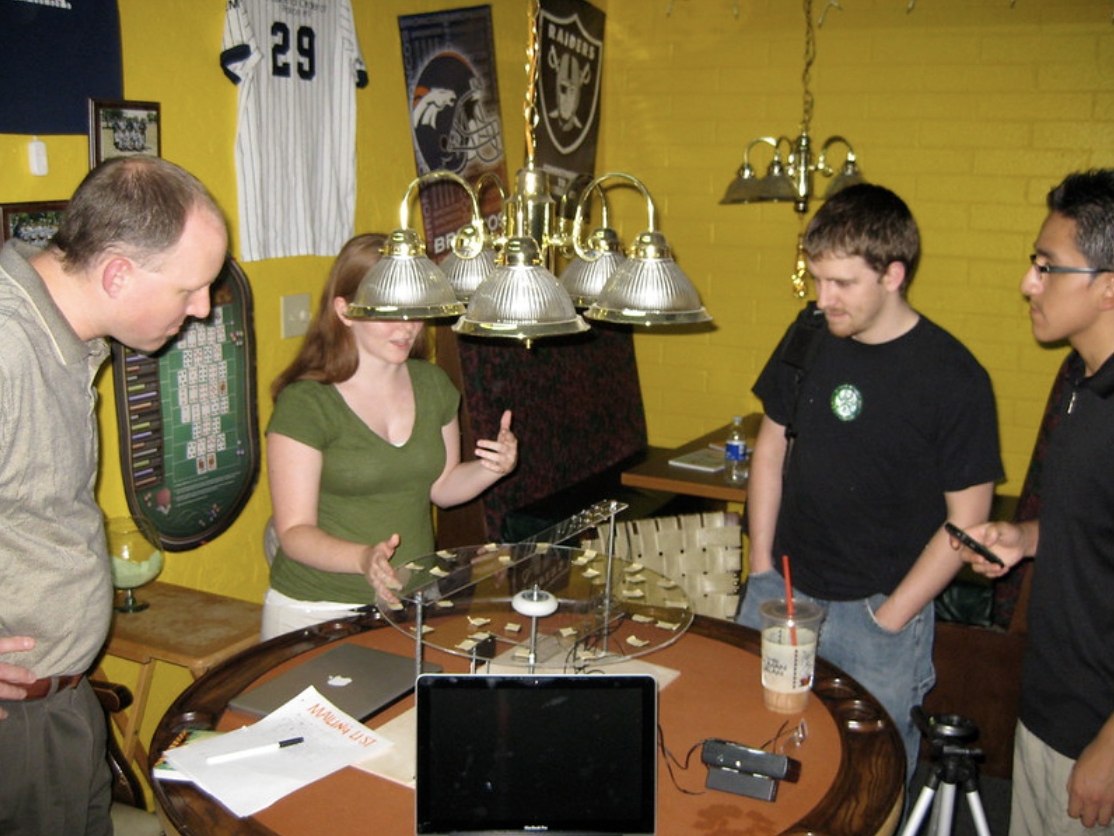
The first thing to know about HSL is that there was no space for almost two years. There was a wiki, a recurring meeting, and a group of post-college locals who wanted to keep working on projects after they lost their school shops.
The earliest wiki edits show up in September 2009, written by a small set of handles: Hexmap, Friedpope, Uberschnitzel, Jjrosent, Drea, and Will. The first wiki "Meetings" page set a cadence the organization still keeps: public meeting on the second and fourth Thursday, social outing on the third. The first project night, dated September 17, 2009, listed exactly one topic on the agenda. Potato cannons.
The meetings themselves happened at Gangplank, a coworking space in Chandler at 325 East Elliot Road, Suite 34. The wiki of the era noted, with preserved enthusiasm, that Gangplank had free Wi-Fi.
Will Bradley, who co-founded HSL alongside Jeremy Leung, Jacob Rosenthal, David Huerta, and others, has written about the early process. The founders didn't invent the shape of the organization from scratch. They studied what other hackerspaces were already doing.
Throughout 2009, the group looked at, and in some cases visited, the spaces that were already running: Noisebridge in San Francisco, Pumping Station: One in Chicago, NYC Resistor etc. They talked to founders, asked what worked, asked what didn't. Then they went to local meetups in the Valley to find anyone else who might want a space like this.
Will's framing of the goal, in an interview not long after, was direct: a place that removes obstacles to people making things, supports a community of creators in Arizona, and provides resources to people, like the recent grads in the founding group, who had just lost their college shop access.
The first public meeting happened on November 19, 2009. Roughly $1,000 was pledged that night, and the group elected its first board. The meeting notes went up on the wiki within days.
A little over a month later, on December 28, 2009, the first draft of the bylaws was written. It established an Arizona nonprofit corporation with a mission statement that has held up well, "a physical environment for mutual self-education and mutual self-enrichment." A three year financial plan and a placeholder for the 501(c)(3) filing went up the same day.
That is the entire founding sequence, start to finish, in about four months. A wiki, a meetup, a board, and a paragraph of mission.
2010 was the boring, necessary year. The group formalized its arrangement with Gangplank, started the 501(c)(3) application, and began collecting membership dues in February. The bylaws were formally adopted.
A wiki page tracking the search for a permanent location was created and would eventually accumulate dozens of revisions, which is a quiet way of saying the hunt was hard. In November 2010, the first "Rules" page went up. That page would, over the following years, become the most heavily revised governance document in the lab's history.
By early 2011, the membership formally accepted that it needed its own facility. A short guide called "How to Run HeatSync Labs" was written to codify the four board roles the organization still uses today.
The numbers were small. About 24 members in April, 28 by May. The May meeting approved a lease on a downtown Mesa space at 140 W Main Street, two doors east of where the lab sits today.
In July 2011, HeatSync held its first meeting in its own space. The laser cutter, which is still a defining tool of the lab, arrived that same month. An RFID based after hours access system was documented in the wiki within days of the move, another fixture that has persisted, in various rebuilt forms, ever since.
The first full year in the building closed with roughly $58,000 in revenue, a surplus of about $24,000, and $29,000 in assets. The organization was in the black from year one.
A decade and a half later, HSL has moved one building east, swapped its equipment over a dozen times, and turned over its membership several times. The mission paragraph from December 28, 2009 still describes the place. The Thursday and Saturday meeting cadence still holds. The decision making forum, now called Hack Your Hackerspace, descends directly from the meetings that happened at Gangplank.
A wiki, a coworking space, and a potato cannon. That was enough to start.
Log in to comment.

No comments yet. Be the first!