
blog
This Month in HeatSync May 2026
A monthly roundup of what got built, broken, organized, donated, hacked, and shipped at HeatSync Labs in Mesa, Arizona.
 moheeb
 1 96
 HeatSync Labs
A stranger walked in, the first 5 minutes determines if they come back
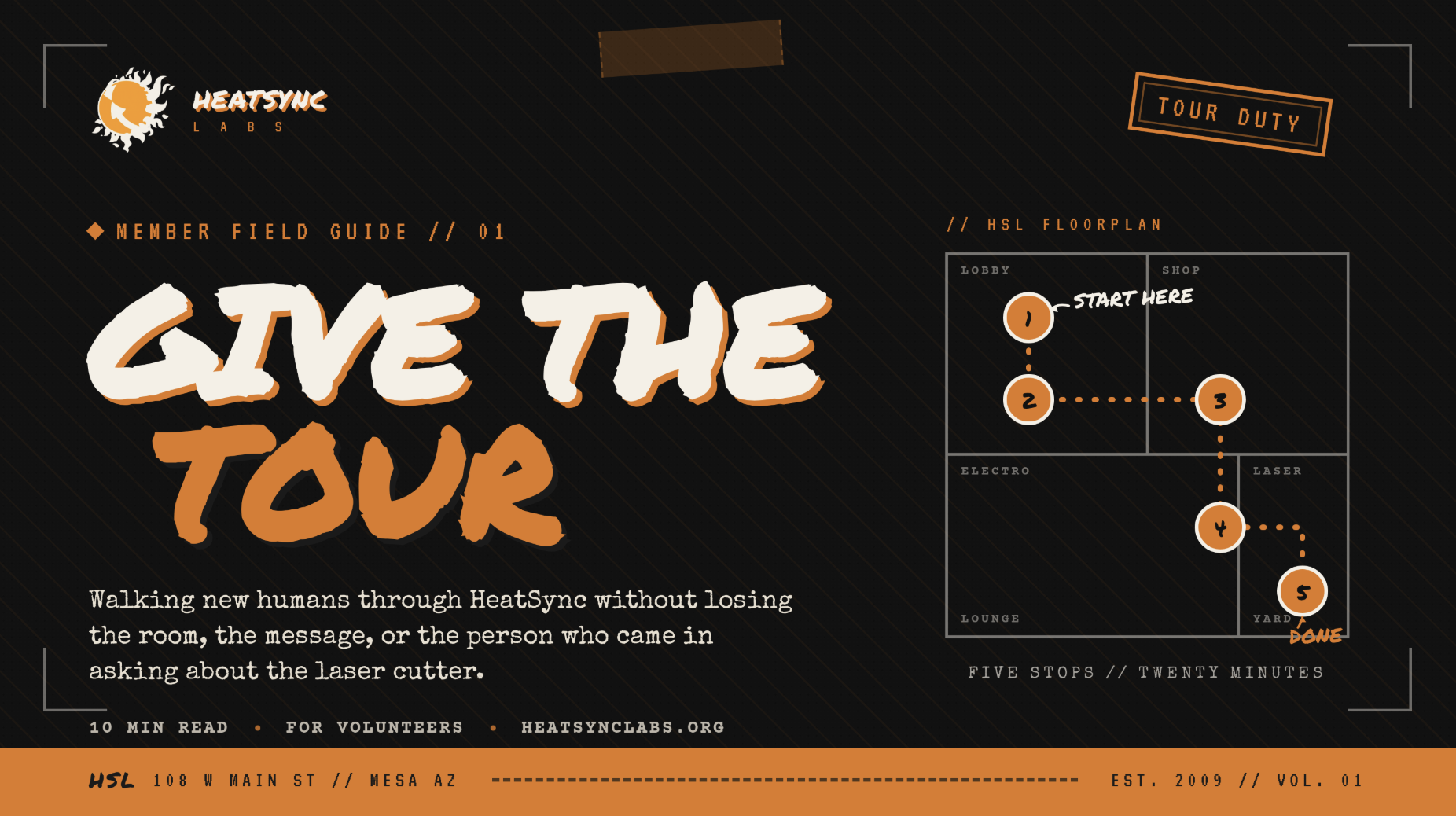
That's all it takes. Five minutes from the moment someone pushes open the door of a hackerspace to the moment they decide whether they'll ever come back. At HeatSync Labs, we don't have a greeter at the door. We don't have a sales funnel. What we have is each other, and a rule that's almost embarrassingly simple: look up.
This is how I think about tours. Most of it lives in the HeatSync Labs Member Handbook, but the rules are the kind of thing you only really learn by doing.
The most important moment of a tour happens before the tour starts. Someone is standing near the door with that specific look: curious, a little out of place, scanning the room for permission to be there.
Walk up. Say hi. Ask what they're working on. Do not wait for them to come to you, because they won't.
The Handbook calls this the Champion role. HSL has an actual board office named Champion, but every member is a champion the moment they look up. If nobody looks up, that person leaves and you never know they were there.
Here's what most people get wrong: a tour is not a sales pitch. You are not closing a deal. You are showing somebody the culture and quietly checking whether they'll fit it. They're doing the same thing back.
That mutual read is the whole point. Spend the first five minutes lecturing about safety rules and membership tiers and you've already lost them. Ignore them because you're elbow-deep in your own project and you've also lost them. The middle path is being a person.
A good tour tells the story of the space. You don't have to hit every stop. Read what excites the person in front of you and lean into that.
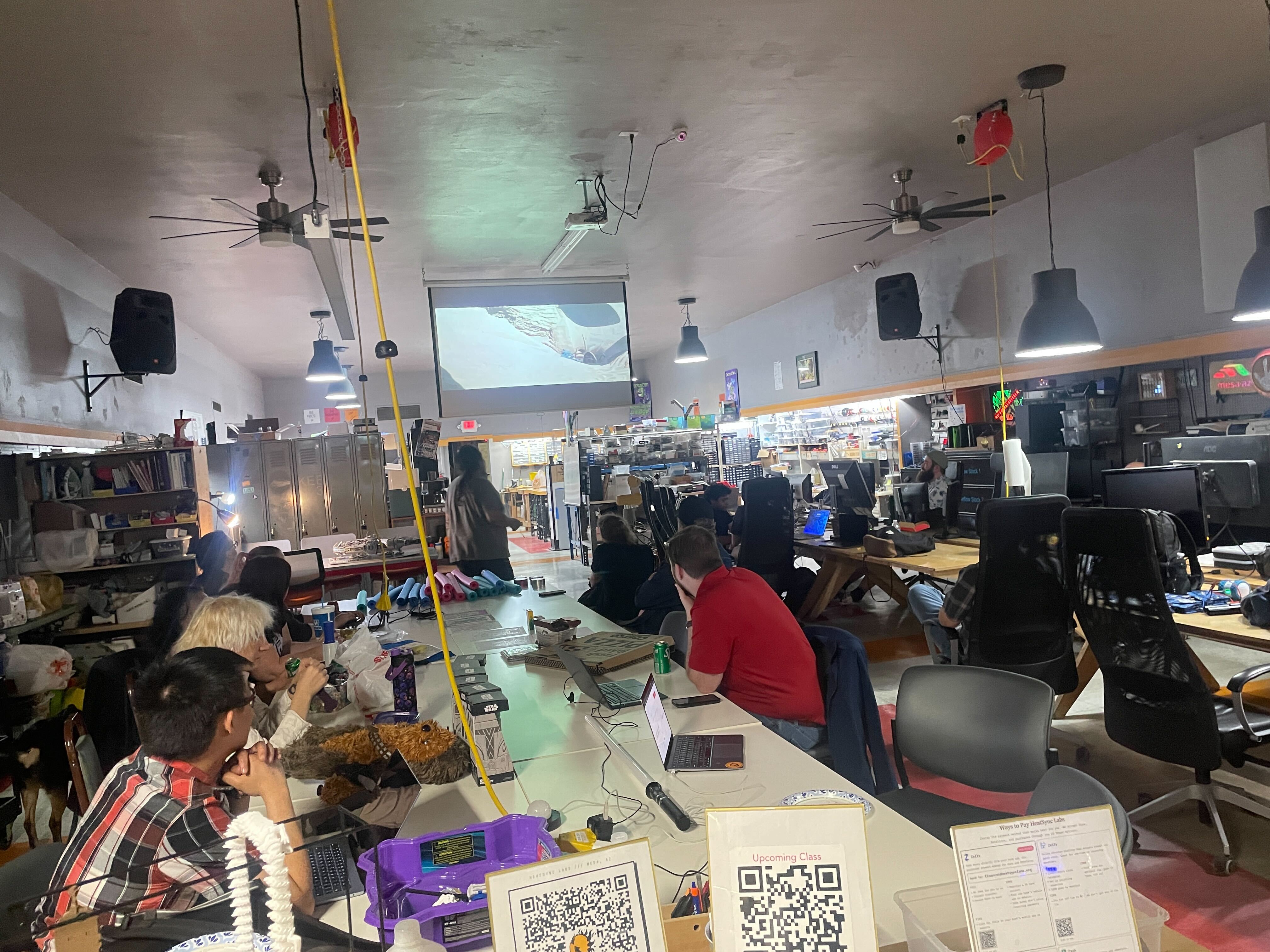
Start at the entrance and main area. Set the vibe. This is where people hang out, collaborate, and work on projects. Everything here was made or brought by members.
If they're a newbie who's never touched hardware, the electronics bench is where I go next. Point them at the calendar. Tell them no experience is required. Arduino Night exists for exactly this reason.
If they came in asking about a specific project, find a member working on something adjacent. Walk them over. Introduce them. Stories sell the space better than tools do.
The laser cutter and machine shop are always impressive, but they come with a caveat: certification is required. Frame that as a feature. "We'll teach you how to use it" lands very differently than "you can't touch this." The 3D printers are an accessible entry point for almost anyone, and a good place to connect newcomers to community projects.
This question comes up on every tour. "Do I need permission to do X?" The honest answer is almost always no, with a few important exceptions. HSL runs on three overlapping systems, and most newcomers find this part of the tour the most useful.
If you want something done, do it. You don't need a vote to organize a drawer, write a wiki page, fix a broken thing, run a workshop, or start a project. The right to decide is earned by doing the work.
This trips people up at first because most institutions run the opposite way. At a job, you ask permission. At HSL, you check whether anyone minds, and if nobody does, you start.
The failure mode to warn newcomers about is vetocracy: people who don't do the work blocking the people who do. The rule is that "no" requires doing. If you want to block something, you're signing up to handle it yourself.
For day-to-day stuff that affects more than just you, the mode is informal agreement. Bring it up at HYH, ask in the Google Group, or talk to the people who'd care. If nobody objects, you're good. Most decisions get made this way.
I tell newcomers to think of it as asking a roommate. You're not voting. You're checking that what you're about to do won't mess up somebody else's day.
A small set of decisions need a formal vote at HYH. These are things that affect shared infrastructure, cost real money, are hard to reverse, or change the rules. The proposal process exists so one person can't permanently change the space without everyone else having a say. For most members, most weeks, it doesn't come up.
The rule I share on tours: if it only affects you, do it. If it affects a few people, ask them. If it affects the whole space or costs money, bring it to HYH. Most newcomers find that freeing once they get it.
Most of what makes a tour good is what you don't do.
The failure modes are all variations on the same theme: making the visitor feel small. Gatekeeping ("do you even know what a hackerspace is?") is the worst version. Overwhelming them with every piece of equipment is a softer version. Hard-selling membership in the first five minutes is a confused version.
What works is the boring stuff. Introduce yourself by name and ask theirs. Ask what projects they're interested in. Show someone else's project and tell the story. Mention HYH and point them to the calendar. Let them touch things, safely. Mention public hours so they know they can come back without committing to anything.
You're not trying to convert anyone. The goal is making someone feel like they could belong here.
They will ask. Have an honest answer ready.
The framing matters. Membership at HSL is a monthly donation, not a fee for service. $25 to be part of it. $50 for storage and card eligibility. $100 for a locker. Public hours are always free, which is the most important thing to mention if money is part of why they're hesitating.
Think about the people who've stuck around at any hackerspace for years. Almost every one of them can name the member who gave them their first tour. That isn't a coincidence. The tour is how trust starts.
You're not building a customer relationship. You're inviting somebody into a community that runs on people noticing each other.
So when someone walks in: look up.
Adapted from the HeatSync Labs Member Handbook. HSL is at 108 W Main St, Mesa, AZ. Stop by during public hours.
Log in to comment.
A monthly roundup of what got built, broken, organized, donated, hacked, and shipped at HeatSync Labs in Mesa, Arizona.
moheeb
HeatSync Labs is Arizona's first 501(c)(3) hackerspace. It lives at 108 W Main Street in downtown Mesa, has been running continuously since 2009, and works the way it does because of a handful of decisions made in its first two years. This is the story of those years, drawn from the lab's own wiki, the founders' writing, and the public archive of meeting notes.
moheeb
Great write up Moheeb. One thing I tell people about the money part is we donate money because we believe the space should exist, not because we get something out of it (but we still get something out of it).